My Self-Imposed Rigorous Tarot Study
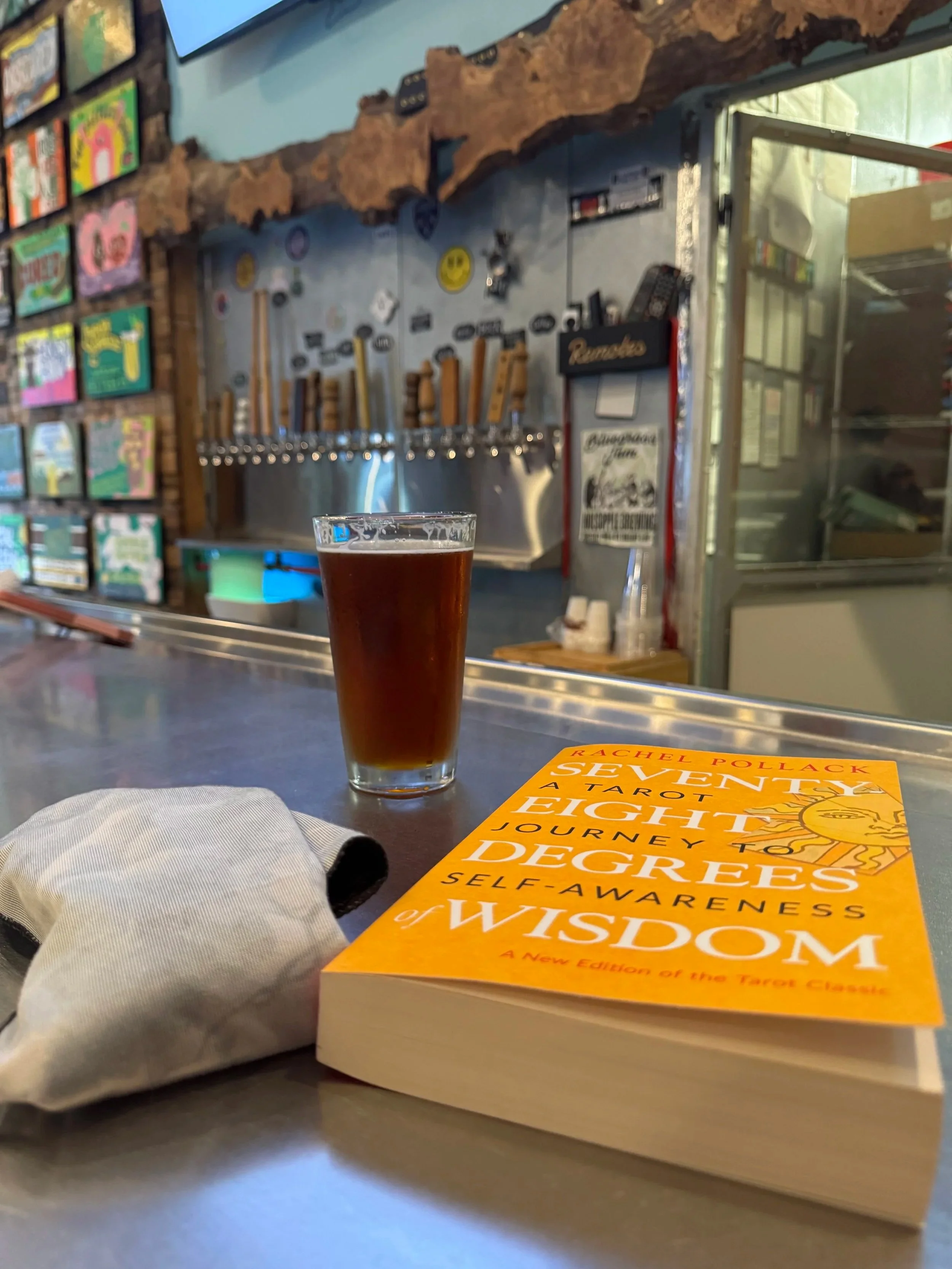
Reading a Tarot book at a sports bar.
It’s been more than a few weeks since I started this blog. My original intention was to try to post weekly, but turns out that’s hard, especially since I was still working out the kinks of juggling academic planning for my teaching job that starts again in a few weeks, my own personal studying of the Tarot stuff, and finding a balance with my other writing projects. Having something new to saw is also an important component to writing a new blog post, apparently.
What’s new for me to say is that I’ve gotten through most of my re-read of Seventy-Eight Degrees of Wisdom by Rachel Pollack. Since I’m diving back into Tarot cards after a 10-15 year hiatus (the math still isn’t quite mathing on exactly when I stopped, but around the time I started college I think) I wanted to really focus on the history of Tarot and the collective meanings of the cards. This is in something of an opposition to the many modern Tarot readers who rely more on intuition. I respect that, and even attempt such feats from time-to-time. However, as an adjunct professor, I find the collective meanings and symbolism much more interesting and useful for my own personal dives with Tarot cards, and even when I read for others.
(Amazon affiliate link for the book here: https://amzn.to/3RkY5cY. I earn revenue from your purchase.)
My History with Seventy-Eight Degrees of Wisdom by Rachel Pollack
As I’ve perhaps over-communicated, I was really into spirituality and Tarot cards and psychic readings when I was a teenager. I was gay, largely lonely, and found great comfort in the ideas spread by the new-age spirtiual movement around the early 2000s. I didn’t even dive into Tarot cards until maybe a decade after, sometime in my early twenties. When I got my first Tarot deck (the 1909 Rider-Waite-Smith deck still miraculously in print today), I nabbed a copy of Pollack’s Seventy-Eight Degrees of Wisdom. I read the beginning sections of it, then used it as reference as I got acquainted with the cards I pulled in readings. I never actually read the whole thing like a book.
And here comes my argument: read it like a book. I guess it took an MBA and an MFA in Creative Writing for me to be comfortable reading a book like this cover-to-cover, but it is so much more useful to me now that I’ve finished reading all of the card meanings.
The reason this book reads better cover-to-cover than most is because what history and collective meanings Pollack gives us about one card is often taken into account as we read about the cards after it, expanding our understanding of previous cards. Many of the cards (The Devil and The Tower, for example) go hand-in-hand and rely on each other’s meanings to better understand their own. While you can use the book as a reference book, you lose that understanding of the arch when doing so.
I’m glad I took the time to actually read all the meanings. Though these are just one person’s opinions on the meanings, she at least incorporates history well enough to give me an understanding of the collective meaning of each card, whether I completely agree with that meaning or not.
Many people don’t like the book because of her 7-7-7 approach the major arcana, and I even have trouble with the "top down” approach to the minor arcana. The major arcana grouped into rows of 7 (with The Fool on its own) does really help with the symbolism though, even as mere ideas to have on the back-burner while using the cards in other ways. And the top-down approach (King down to Ace instead of Ace up through King) as the arcs for the minor arcana are from Waite’s text anyway, so it’s difficult to argue that it absolutely has to be the other way around. Now i have both directions to wade through as I work with the cards, and sometimes one way makes sense more so than the other. It’s important to note that the book was originally published in the 80s. As a professor of writing, I can assure you that meanings of any language system (which we could argue the Tarot is one of ) change over time, so it can be somewhat difficult to resonate with some of the more traditional values of the early 1900s, which this deck came out of.
I can’t stress enough that I like Tarot cards because they help me think through questions and possibilities. They’re a psychical tool that I can put on the table and get my mind thinking outside of the box. With a better grip on the collective and historical meanings of the cards, they’re much more useful for me.
Up Next: Mary K. Greer’s Tarot for Yourself or The Tarot Court by Mary K. Greer and Tom Little.
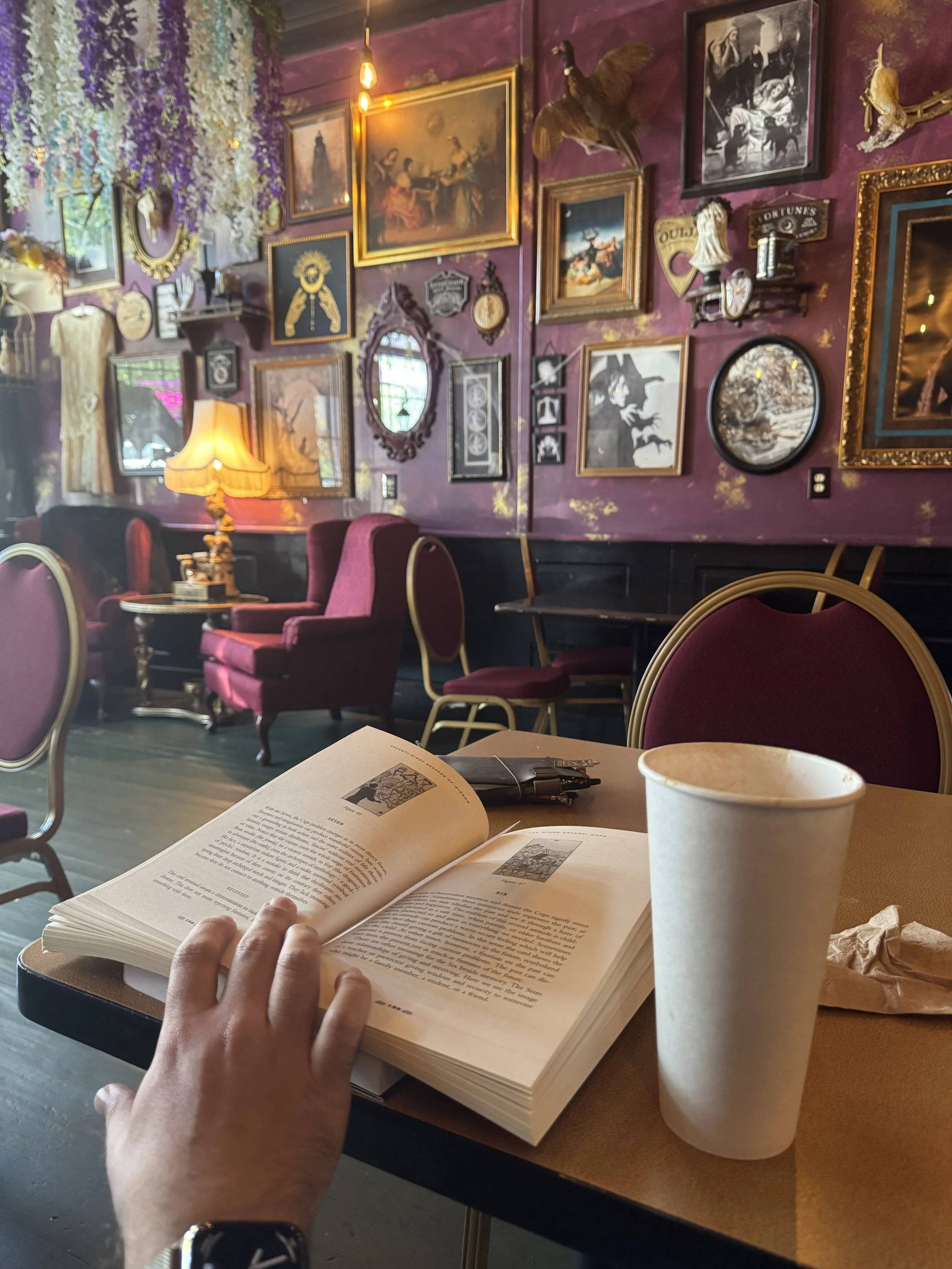
Reading Seventy-Eight Degrees of Wisdom at Witches Brew Coffee in the Clifton area in Louisville, KY.
I’m definitely going on something of a self-imposed rigorous Tarot study from an academic standpoint, which will likely take a long time. Up next, after I finish off the remaining pages of Pollack’s book (I still have to finish her run-throughs of the Celtic Cross and other spreads), I’m going to dive into either Tarot for Yourself, a Tarot workbook I started in my early twenties but didn’t finish, once I started college, or The Tarot Court, another book by her that I’ve actually never read. I’ll probably do much of the same method–read at coffee shops, bars, .etc.
I’ve started reading for others more, and even have services available on my website, but I know it takes time to get into the swing of things. I’m still figuring out exactly how to juggle the academic work and the Tarot studies and work. I’m probably annoyingly practical about how I do readings (less intuitive-led, more creative or Jungian in style). I’m also still figuring exactly how I would explain my Tarot card use to other academics, or if I even should.
I’ll let you know how the next book study goes. Let me know which one you think I should do.